Cybersecurity: What You Need to Know to Protect Yourself and Your Business
07.07.2026

Photo: Magnific.com
Recent events in Latvia and around the world have once again highlighted the growing importance of cybersecurity awareness and digital literacy. As the number of cyberattack attempts continues to rise, it is becoming increasingly clear that technological solutions alone are not enough. Knowledge, the ability to recognize potential threats, and knowing how to respond appropriately are equally essential. Time and again, a lack of awareness and simple human errors have proven to be extremely costly—and the consequences are not always measured solely in financial terms.
BDA instructor and cybersecurity expert Viktors Meirāns shares practical advice on how individuals and organizations can better protect themselves in the digital environment and avoid falling victim to increasingly sophisticated cybercriminals.
Cyber Threat Levels Remain High in Latvia and Worldwide
Photo: Magnific.com
According to the latest research by the U.S. cybersecurity company Total Assure, the global cybersecurity landscape remains alarming. At the beginning of 2026, ransomware attacks worldwide increased by 32%. After analyzing more than 2,800 confirmed incidents across 96 countries and 22 industry sectors, researchers concluded that cybercriminal groups are becoming more organized and are employing increasingly sophisticated attack techniques.
This trend is also reflected in the latest statistics published by CERT.lv. In Latvia, phishing remains the most common type of cyberattack. Cybercriminals impersonate trusted organizations such as banks, postal services, courier companies, and other well-known institutions by sending fraudulent emails and text messages. These messages are designed to create a sense of urgency, encouraging recipients to take immediate action—for example, logging into their online banking account, clicking a malicious link, or entering personal and payment card information.
The ultimate goal of these attacks is to gain unauthorized access to users’ credentials or other sensitive information, which can later be used to steal money or compromise corporate information systems.
Is Having an IT Specialist Enough?
Many organizations mistakenly believe that having an IT specialist on the team means all cybersecurity concerns are covered. While an IT professional may be responsible for managing servers, workstations, and user accounts, this does not automatically mean they possess all the specialized knowledge required to proactively prevent cyber incidents, secure critical infrastructure, or stay ahead of the latest tactics used by cybercriminals.
This is where internationally recognized cybersecurity certifications become particularly valuable. They demonstrate that a professional has the knowledge, practical skills, and competence required to respond effectively to security incidents and other high-pressure situations.
It is important to understand that a certification is far more than simply passing an exam or obtaining a formal credential. Before earning certification, professionals typically complete intensive training programs led by experienced instructors. These programs usually consist of approximately 40 academic hours and focus heavily on practical, hands-on learning.
Throughout the training, participants work through realistic cyber incident scenarios, participate in simulations, and develop the practical skills needed to identify, analyze, and mitigate a wide range of cyberattacks and security incidents—not just understand the theory behind them.
How to Avoid Becoming the Next Victim
Unfortunately, people continue to represent the weakest link in cybersecurity. A single click on a phishing email can be enough to trigger a serious security incident. This is precisely why providing employees with regular cybersecurity training is just as important as deploying firewalls and other technical security measures.
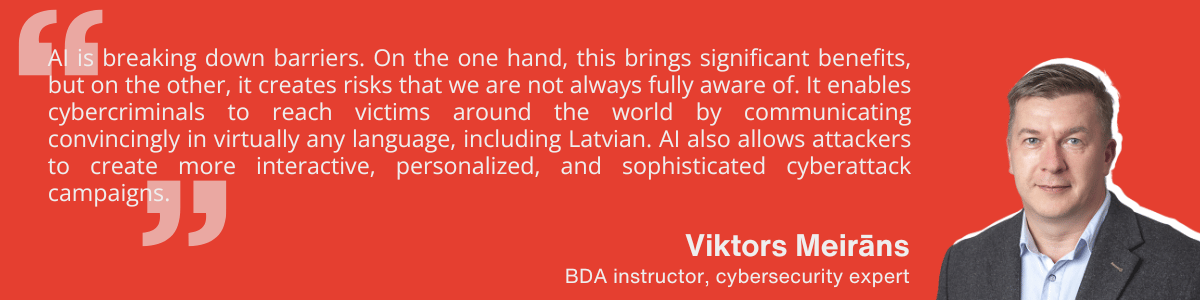
Today, artificial intelligence (AI) tools have become an integral part of our daily lives—and cybercriminals are making use of them as well. Could AI be considered one of their most valuable allies?
What Should You Pay Attention to in Emails and Text Messages?
One of the first things to look for is the quality of the language. Grammatical mistakes, awkward phrasing, and unnatural sentence structures often reveal phishing attempts, especially since AI tools still do not always handle the Latvian language perfectly. If you receive an email that appears to come from someone you know, it is always a good idea to contact that person directly to verify that they actually sent the message.
While It’s Impossible to Eliminate Cyber Risks Completely, How Can We Strengthen Our Digital Security?
There are three essential steps that everyone should take.
1. Install a DNS Firewall
A DNS firewall is a free security tool developed by CERT.lv and NIC that is available to everyone in Latvia. It is designed to reduce the risk of phishing, malware, and other cyber threats. When the system detects a malicious website or online resource, it automatically blocks access, preventing cybercriminals from reaching your sensitive information.
The tool can be installed on both computers and smartphones. More information is available at https://dnsmuris.lv/.
2. Enable Multi-Factor Authentication (MFA)
Whenever possible, activate multi-factor authentication. This means that, in addition to your password, you must verify your identity using another authentication method, such as a unique code sent via SMS or generated by an authentication app.
According to Microsoft, enabling multi-factor authentication can prevent up to 99% of account compromise attacks.
3. Install Reliable Antivirus Software
Keeping reputable antivirus software installed and up to date provides an additional layer of protection against malware, ransomware, and other cyber threats.
One Password for Everything: A Mistake to Avoid
Never use the same password across multiple websites or services. If a single account—for example, your Facebook account—is compromised, cybercriminals can quickly attempt to use the same password to access your other social media accounts, email, online banking, and additional services.
Furthermore, once a password has been stolen, there is no way of knowing how it will be stored, shared, or exploited in future attacks.
How Often Should You Change Your Password?
According to the U.S. National Institute of Standards and Technology (NIST), there is generally no need to change a password regularly if it is strong, unique, and protected by an additional authentication factor such as multi-factor authentication.
However, if your organization’s security policies require password changes at regular intervals—for example, every three months—those requirements should always be followed.
Are Password Managers Really the Safest Way to Protect Your Passwords?
Ideally, the most secure approach is not to rely on passwords at all. Today, many social media platforms, service providers, and businesses have already adopted passwordless authentication.
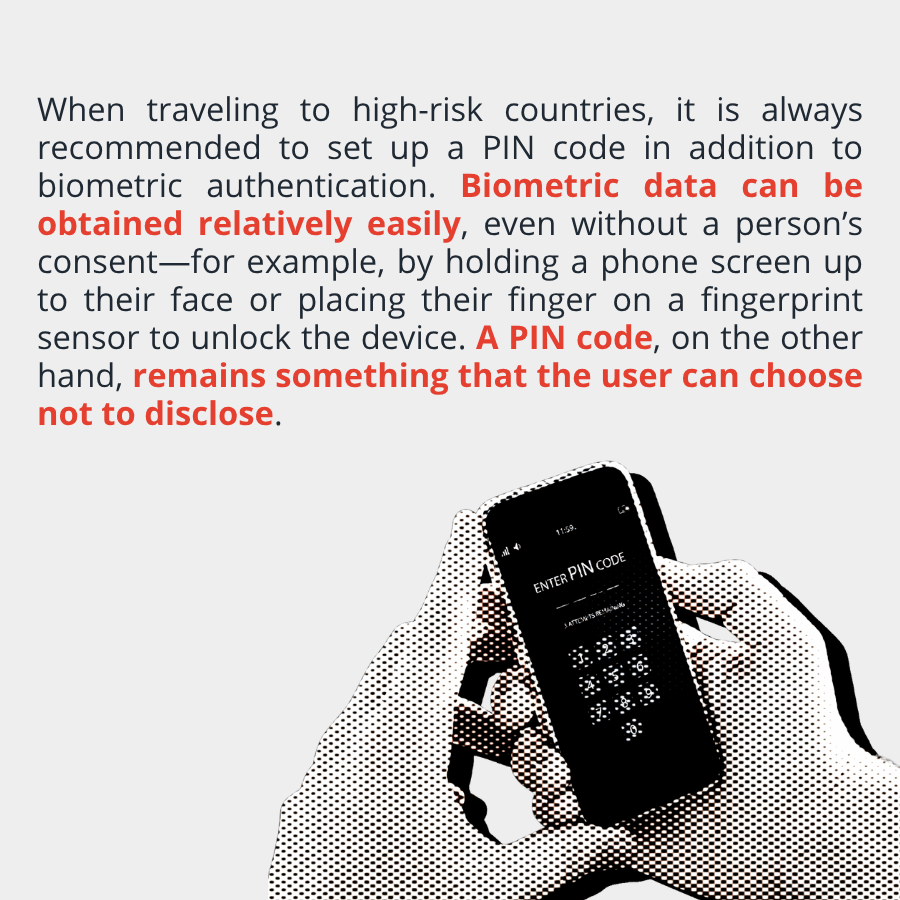
With passwordless authentication, users can sign in using biometric verification, such as a fingerprint or facial recognition, or through secure authentication methods like Smart-ID PIN codes, eliminating the need for traditional passwords.
That said, if you do use passwords, a password manager remains the safest option. It generates a unique, complex password for every account, so you do not have to remember each one individually. Instead, you only need to remember the master password for your password manager—which should, of course, be protected with the highest level of care.
Backups Can Save a Business
How Important Are Backups, and Are They Worth Creating?
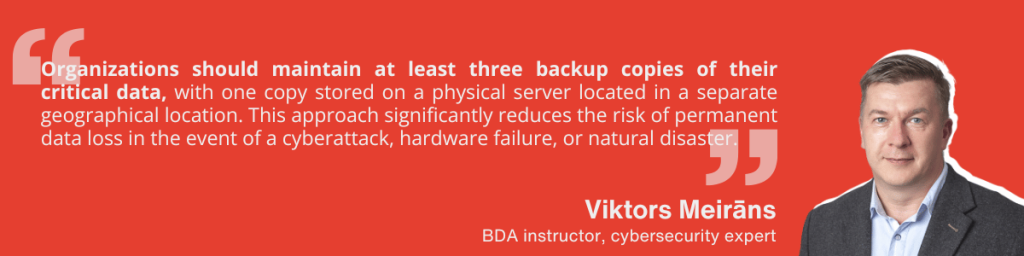
Creating backup copies is one of the most important preventive cybersecurity measures any organization can take. Even if cybercriminals manage to steal or encrypt company data, a business with reliable backups can recover by simply restoring its systems from those copies.
Without backups, organizations risk permanently losing critical files, business data, and even customers, while also suffering significant reputational damage.
Where Is the Best Place to Store Backup Copies?
For individuals, cloud storage services such as Google Drive, Microsoft 365, and Microsoft OneDrive offer a practical and effective solution. These services automatically back up documents, photos, and other important files to the cloud, providing an additional layer of protection and making data recovery much easier if devices are lost, damaged, or compromised.
A Cyberattack Has Been Detected. What Is the Correct Course of Action?
The appropriate response largely depends on the specific situation and the nature of the incident. Individuals can report suspected or confirmed cyberattacks through the CERT.lv website and should also immediately contact the administrators of the platform or service where their account has been compromised.
What Should an Organization Do?
Organizations should have the previously mentioned backup systems in place to ensure business continuity and avoid being forced into negotiations with cybercriminals. In addition, every organization should have a carefully developed incident response plan and recovery strategy.
Another possible solution is cyber insurance. This service is becoming increasingly popular internationally because, in the event of a cyber incident, the insurer can cover the resulting financial losses. However, without such a “safety net,” organizations must take preventive measures themselves by strengthening their resilience in the digital environment. This includes providing regular cybersecurity training for all employees.
Expert Advice
Strengthening Cybersecurity Is a Long-Term Strategy
Cyberattack methods and strategies are constantly evolving, as attackers continuously search for new ways to gain access to organizations and their employees. A company leader does not necessarily need to personally analyze security vulnerabilities or configure firewalls. Their responsibility is to ask the right questions:
- Do our IT specialists hold valid cybersecurity certifications?
- Does our organization have a clear action plan in place for responding to cyber incidents?
- Are employees regularly trained to recognize phishing attempts?
- Do we regularly test our security procedures in practice?
If several of these questions cannot be answered confidently, it is a clear sign that the organization’s cybersecurity resilience needs to be strengthened now—not after an incident has already occurred with potentially unpredictable consequences.
In-Demand Cybersecurity Training Courses and Certifications:
Long-term resilience against cyber threats depends on people’s knowledge, continuous skills development, and the ability to adapt to an ever-changing threat landscape. Therefore, it is essential not only to establish strong security policies and strategies but also to make targeted investments in employee education and professional development.
At BDA, you can gain internationally recognized cybersecurity knowledge and earn certifications that are highly valued in today’s job market. Take care of your own and your organization’s security by staying informed about the latest cybersecurity challenges and solutions!
Recent Posts