
How Can Artificial Intelligence Become a Useful Learning Assistant?
17.04.2026

Education is not just about reading books and attending lectures—it is an interactive, dynamic, and engaging process in which newly acquired knowledge is purposefully connected to real-life situations and practical examples. That is why artificial intelligence is playing an increasingly important role in the learning process, as it can also serve as a personal assistant tailored to each individual’s needs and goals—whether for acquiring new skills, changing career direction, or simply refreshing knowledge. In this article, discover how the use of AI tools can enhance the learning process, making it more engaging, meaningful, and effective!
Artificial Intelligence as a Valuable Support in Learning
Artificial intelligence is significantly changing the way we perceive and process information. It can analyze facts, adapt content, create clear summaries or self-assessment tests, and provide instant feedback and recommendations for more effective learning.
A Personalized Approach
The use of artificial intelligence tools in learning can be highly versatile. For example, they can be used for:
- explaining complex concepts and terms in simple, easy-to-understand language;
- offering additional exercises on topics that are not yet fully understood;
- adjusting the learning pace.
Availability
With tools such as ChatGPT, Copilot, or Gemini, it is possible to learn anytime and anywhere. By simply asking a question, you can receive an answer and a detailed explanation within seconds. This is especially useful when a teacher is not available or when following a self-directed learning approach.
Wide Applicability Across Different Fields
Artificial intelligence as a learning assistant can be applied in various fields—from gardening to complex programming topics. As a result, it becomes a universal tool suitable both for beginners exploring a new field and for experienced professionals.
Step by Step: How to Use AI Effectively in Learning

Photo: Freepik.com
To truly benefit from AI, it is important to use it thoughtfully and purposefully.
1. Ask Specific Questions
The more precise your question, the more specific the answer. Instead of asking a general question about Microsoft Excel functionality, ask AI to explain a specific function or a particular issue you have encountered or did not fully understand during your studies.
2. Request Practical Examples and Additional Tasks
Learning becomes more effective when theoretical knowledge is linked to practical examples. AI tools make it quick and easy to create self-assessment tests and develop real-life scenarios.
3. Use AI as a Mentor
Using AI tools is an interactive process in which your active participation is essential. The more you engage—by analyzing, and guiding the conversation—the more valuable the results. AI can support idea development, provide personalized recommendations, and deepen understanding.
Writing Effective Prompts
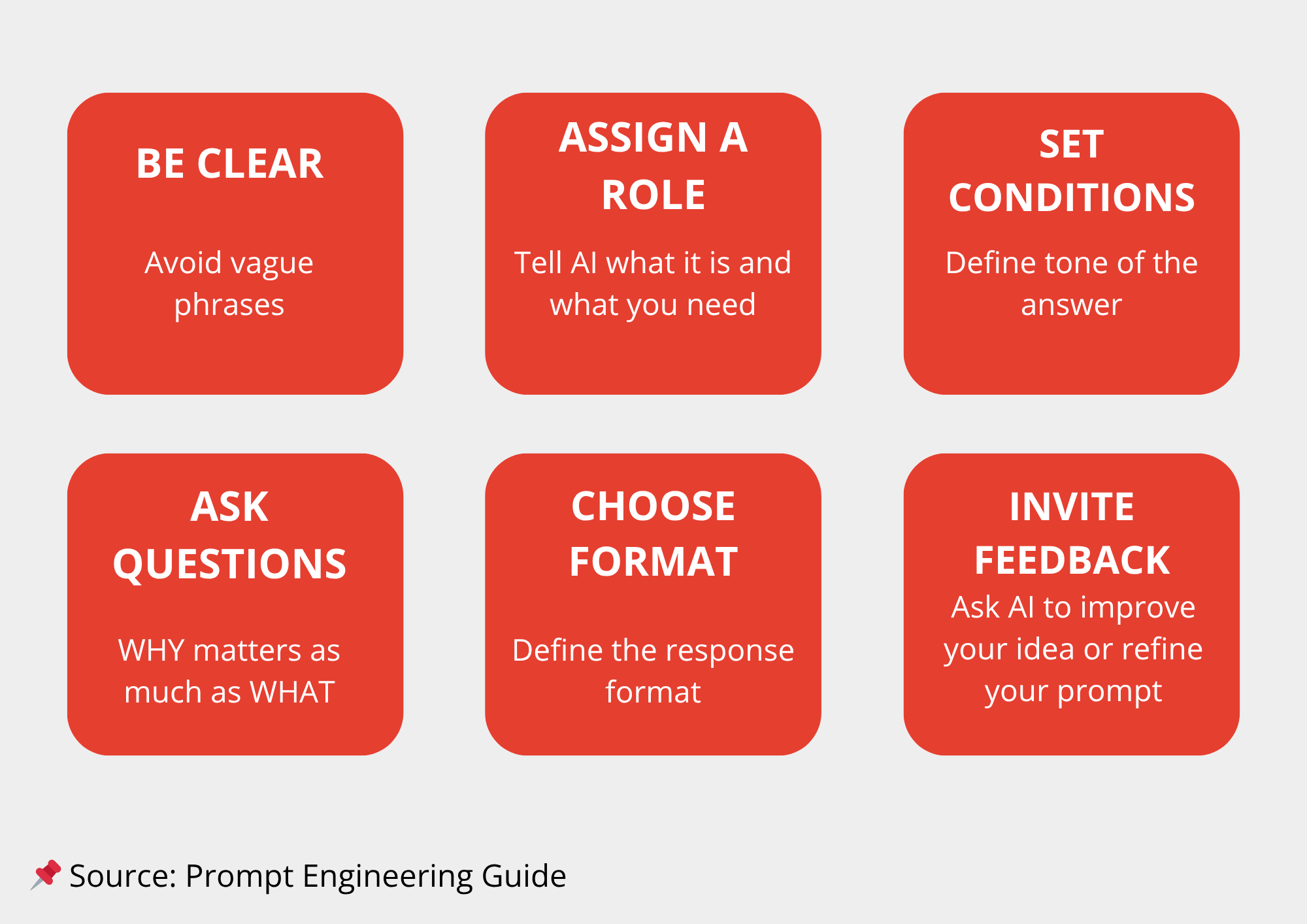
One of the most important aspects of working with AI is the ability to formulate questions or tasks correctly. A good prompt is specific, structured, and goal-oriented.
EXAMPLE 1
“Please tell me about project management.”
EXAMPLE 2
“You are an experienced project management professional with practical experience in the IT industry. Your task is to help a beginner understand the basics of project management. Explain the key concepts in simple, clear language and include three specific examples from the IT field.”
Comparing these examples clearly shows the importance of precision when working with AI. The first example is too general—it does not define a goal or a role, so the response is likely to be superficial.
The second example includes several important elements: it clearly defines the need for an explanation of project management basics, specifies a role, and requests concrete examples. This allows AI to adjust both the language and the complexity of the explanation.
Five Practical Tips for Writing Effective Prompts
- Always provide context
Example: “I am a beginner in programming…” - Define the goal and role
Specify whether you want a detailed explanation, a short summary, or additional tasks. - Specify the format of the response
For example: narrative, table, or visual diagram. - Ask for examples
Examples improve understanding and clarity. - Refine your prompt if needed
If the response is too general or insufficient, clarify your question.
Advantages of Artificial Intelligence
For adults who often combine learning with work and daily responsibilities, AI offers several important benefits:
- Flexibility and speed—questions can be asked anytime, anywhere.
- Personal and professional development—AI can help identify knowledge gaps, create structured and personalized learning plans, and track progress.
- Skill reinforcement—not only learn theory but also understand how to apply knowledge in practice.
The Importance of Critical Thinking
It is important to remember that AI-generated information should always be critically evaluated and verified using reliable sources. While AI tools are valuable, they cannot replace a high-quality learning process led by an experienced instructor.
Artificial intelligence is already transforming the way we learn and grow. However, what matters most is not the tool itself, but how we use it. At BDA, you can learn not only how to use AI tools effectively to save time and increase productivity, but also cybersecurity, programming, project management, and many other fields. Sign up for a course, and use AI as your trusted learning assistant!
Recent Posts