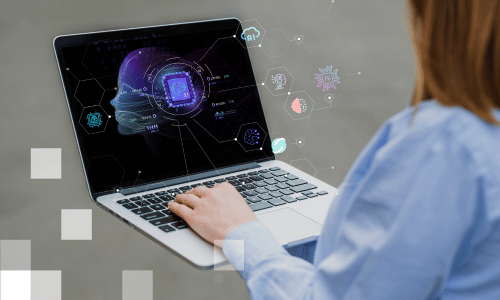
AI for Team Leaders: Leadership, Decision-Making and Team Development
During this course, participants will not only learn how to practically apply artificial intelligence (AI) tools for self-management, efficiency, and team support, but also how to use them in alignment with their way of thinking, reflection, and leadership identity—for self-awareness, improving decision quality, and developing their leadership style.
The course focuses on real-life managerial situations and challenges, including providing feedback, leading difficult conversations, motivating teams, and reducing employee burnout risk. You will have the opportunity to learn how to integrate AI into various daily processes while maintaining focus on the competencies that are most essential during times of change. You will also strengthen the human skills needed to maintain psychological safety and improve the quality of relationships with others.
The training program is designed based on insights from Gallup’s 2025 data on declining manager engagement, employee anxiety, and the importance of trust in the workplace.
Plans
Contact us
Apply or ask a question!
If you want to apply for the course or ask a question about it, feel free to use this form. |
||||||||||||||||
|
||||||||||||||||
Course target
Building advanced understanding and practical skills in:
- the appropriate use of AI to support managerial decision-making, reflection, work planning, and the preservation of personal energy and resources;
- the transformation of the manager’s role and the development of new skills required to lead teams in an AI-first work environment, including strategic thinking, data literacy, and ethical reasoning;
- using AI as a thinking partner in personal leadership development—for defining one’s own “leadership challenge,” supporting reflection, and unlocking team potential;
- reducing team anxiety, uncertainty, and the risks of “shadow AI” by fostering a safe, ethical, and transparent AI usage culture;
- strengthening the manager’s ability to maintain empathy, presence, trust within the team, and sustainable leadership capacity;
- developing managerial competencies that, according to Gallup, are critical for increasing team engagement and well-being, as well as reducing the decline in engagement.
Audience
New and experienced team leaders who manage people and make decisions in environments shaped by data, complexity, and uncertainty, and who want to confidently and responsibly integrate AI into their leadership practice.
At Course Completion you will be able to
-
Understand the key “pain points” of team leaders in the AI era and their underlying causes, based on Gallup’s 2025 surveys and research.
-
Use a wide range of AI tools and methods consciously and responsibly, selecting the most appropriate approach for specific leadership situations.
-
Apply AI as a partner in leadership and career development, clearly articulating leadership challenges, strengthening management capabilities, and choosing appropriate decision-making approaches and action plans through structured AI dialogues.
- Reflect on one’s own mindset, beliefs, and leadership identity using self-coaching techniques, with the aim of improving decision-making quality and preserving personal resources.
-
Leverage AI tools to prepare feedback, evaluate decision alternatives, and plan team conversations, while maintaining ethical and responsible practices.
-
Establish and communicate clear “rules of the game” for AI use within teams, helping reduce anxiety, promote psychological safety, and encourage open dialogue about technology use.
-
Intentionally balance AI-driven efficiency with empathetic, human-centered leadership, avoiding the trap of operating on “autopilot” and preserving meaningful relationships with team members.
Prerequisites
Basic digital skills and a willingness to experiment with different AI tools are required.
Training materials
Training materials and practical examples prepared by BDA, enriched with insights from international research and case studies on the implementation of AI in leadership and team management contexts.
Certification Exam
Not intended.
Course outline
Module 1. The Age of AI and the New Role of the Leader
-
The impact of AI on the work environment and leadership: why 70% of AI initiatives “stall” due to a lack of leadership skills and direction.
-
Typical “pain points” of team leaders in the context of AI: a drop in engagement from 23% to 21%, manager burnout, employee anxiety related to AI, and fear of replacement (based on Gallup 2025).
-
The transformation of the leader’s role and the critical skills required to enhance organizational competitiveness. AI can help more precisely define and deepen one’s core leadership challenge.
Module 2. AI as a Personal Leadership Coach and Thinking Partner
- Leadership development: how AI can help more clearly define and deepen one’s core leadership challenge.
- Decision reflection: preparing for difficult conversations, increasing awareness of one’s leadership style, and planning future development goals.
- Personal ethics framework: what to delegate to AI (analysis) and what to retain (empathy, values, decisions); preserving personal resources and building resilience.
- Analysis of beliefs, values, and identity at both individual and team levels using AI-supported self-coaching.
Module 3. AI in Everyday Leadership Situations
-
Understanding the team and supporting direction: AI as a personal resource for setting priorities and gaining a systemic overview.
-
AI as support in daily tasks: creating meeting summaries, generating ideas, monitoring KPIs, and analyzing scenarios.
-
AI as a preparation tool for difficult conversations and feedback delivery: discussions on performance, conflict situations, change, priorities, and expectation alignment.
Module 4. AI Integration in Teams: Safety, Ethics, and Culture
- Team coaching methods for AI integration: how leaders can use AI to shape team culture.
- “Shadow AI” risks and security measures: consequences of non-transparent AI use in terms of quality, reputation, and data protection; safe practices (personal data, confidentiality).
- AI-related employee anxiety and psychological safety: fostering open communication, skill development, and trust.
- Ethics and fairness: guidelines for transparent decision-making, preventing discrimination risks, and ensuring ethical use of AI within the team.
If you want to get more information about this course, please contact us by phone +371 67505091 or send an e-mail at mrn@bda.lv.